Just the same as electronics, this is the list of stuff that you'll need to get you started. I'm assuming that you're looking to build small things, by small things I mean enclosures for your projects, hifi speakers, pictures frames or small boxes etc. This list of tools will enable you to build a huge project like a tree house, or a wooden bike, but before you embark on any project like that you need to not only have the basic tools, but also the ability and practice to use them. (there's that word practice again, yes, working with anything and creating anything is a skill, to develop skills you have to work at them. that's the difference between first year/grade and final year projects, you've spent years practising by the time you get to your final year so you've got more knowledge and more skills.)
Anyway, this list should get you started.
A clamp
There are many different kinds of clamps, G clamps, C clamps, sash clamps. clamping devices come in all different shapes and sizes.
The reason that I put a clamp at the top of the list is because I believe that this is the most important thing that you want.
Your project might only be gluing two bits of wood together, unless you want to sit all night holding the bits together by hand, a clamp is essential.
You can also use a clamp to hold a piece of material to a surface as you cut material off of it.
(it's much easier to cut through something when it's held steady!)
You can get an idea of the variety and kinds of clamps available by looking here;
http://search.diy.com/search#w=clamp
As a starter set I'd say that you couldn't go wrong with buying a cheap set of three C clamps. they come in different sizes enabling you to work on a variety of projects sizes.
Cost £5 (total cost £5)
A Saw
You've got a way to put things together, now how about a way to take things apart?
Saws come in all variety of shapes and sizes, and are used for different things.
your average hand saw costs less than £10 and has a blade that can do cross cut (cutting through the grain of the wood), or rip cuts (cutting along the grain of the wood.)
If you plan on making only big things, then a large 9ppi saw is probably all you need that'll rip through wood quite fast, if you're planning on making much finer stuff (furniture for example) you might want a saw with finer teeth, perhaps 14ppi.
What's PPI? PPI means points per inch, it's the amount of teeth on a saw inside of one inch measured along the blade. it's as easy as that.
Saw teeth rip through things by wearing them away, the more saw teeth that there are in a given inch, the finer the teeth will be, and the cleaner the cut that they make will be, though the longer it'll take to get through the material you're cutting, as it'll rip away less material on each pass.
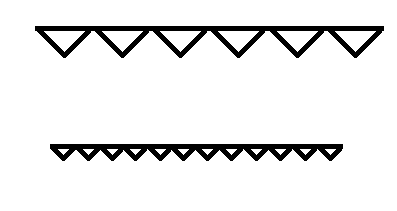
the picture on top represents a 7ppi blade, the one on the bottom a 14ppi blade, the 14ppi blade is clearly much finer.
As a starter, I'd recommend that you get an all purpose hand saw like this
http://www.diy.com/diy/jsp/bq/nav.jsp?action=detail&fh_secondid=9676731&fh_location=//catalog01/en_GB/categories%3C{9372015}/categories%3C{9372043}/categories%3C{9372176}/categories%3C{9392049}/specificationsProductType=hardpoint_saws
Cost £3.50 (total cost £8.50)
There are of course different saws for different jobs, a fret saw is used for cutting shapes as the blade is very thin and can turn corners.
A coping saw has a round blade and can cut up, down and side to side.
A tenon saw has a metal bar that re-enforces the top of the blade to make sure that it doesn't move of flex. As with most tools, different saws are suited to different jobs. I don't recommend buying them all at once, but certainly if you have a specific job that requires a specific tool then you should buy that tool.
Tape measure
Ok, so you can hold your work piece still now (clamped to the kitchen table), and you can cut through it, but how will you need to know where to cut?
Get a tape measure.
Cheap tape measures might lack a cool feature like being able to lock the tape out, but they work just as well at measuring stuff. So just grab a cheap one.
Cost £5 (total cost £13.50)
Square
So now you know where to cut, you'll want to draw a line on the wood that you're cutting, of course you want to make sure that your line is perpendicular to the edge, not going off at an angle, so you'll want to use a square.
http://www.diy.com/diy/jsp/bq/nav.jsp?action=detail&fh_secondid=11247668&fh_location=//catalog01/en_GB/categories%3C{9372015}/categories%3C{9372043}/categories%3C{9372176}/categories%3C{9392047}/specificationsProductType=measures/specificationsSpecificProductType=squares
That set I've linked to has a L shaped piece of metal that you can put on top of a piece of work (where you can't get to the edge) and line up the work with the square, and a thing that is like a ruler, with an adjustable piece of metal on it, the adjustable piece of metal slides in and out allowing you to set it a distance from the end, it also has 90 degree and 45 degree edges.
Cost £10 (total cost £23.50)
Marking
I have of course assumed that you already have a pencil, or a pen to mark your surface with.
this is your choice, you can buy those big square carpenters pencils (and get to feel really manly as you sharpen them with a knife!). You you can go to a pound shop and buy a pack of regular pencils, and a pack of chunky markers, and a pack of fine markers. (for a pound per pack.)
Cost £3 (total cost £26.50).
Hammer
Used the world over for making noise.
There are many many different types of hammer. I've got more than 1 hammer, (cross pein, ball pein, claw, club, rubber).
I'd recommend that you get a few different types of hammer too.
I'd really recommend a 12oz ball pein hammer (the one that looks like it has half a ball on the opposite side to the flat side.)
a 4oz cross pein hammer, sometimes called a pin hammer (the really light weigh one that has a flat chisel like looking part opposite the hammer surface.)
and a 16oz Claw hammer, (the one with a curved surface opposite the hammer face for pulling out nails.)
These hammers will cost £5 - £10 each they all have different uses.
The smallest cross pein hammer is used for fine work, like hammering in veneer pins into some work.
The ball pein is actually more of a metal work type hammer, but I tend to find that I use this the most as the weight of it feels right to me.
The claw hammer is the heaviest and can be used for much heavier work, (driving in big nails). Personally I find that, even though there is only a 4oz difference between the ball pein and the claw hammer, that added weight makes the hammer more unwieldy, and less suitable for fine work. If the hammer is unwieldy then it's harder to control, and you;re more likely to hit your fingers.
Cost £30 (total cost £56.50)
Punch
No, not the drink, the tool, it's basically just a metal rod that you use for pushing nails below the surface, or driving nails to the surface in places where you don't want the hammer face to have any chance in coming into contact with or marking the work that you're doing.
You can just use a really big nail, but since a set of five of these (in different sizes) is only £6 (on DIY.com,) you may as well get the right tool for the job.
Chisel
This is one of those things where you'll really get what you pay for, but also one of those things where good tools cost good money.
For a start I'd recommend (from diy.com) the B&Q value set of three chisels, there are three different sizes, and they are sharp when you buy them at least.
Basically these are good enough. Chisels do get blunt, so you may want to consider a sharpening stone too.
When I first started out I bought the B&Q value set, and used these until they were pretty blunt, you'll know when they get blunt because they become difficult to work with, they don't cut well, require more force, slip more (read between the lines here, blunt tools are difficult to work with, and will slip around on your work piece, i.e blunt tools are more dangerous than sharp tools.) Anyway, later on, when the chisels needed sharpening, I bought a different (better) set, that came with a sharpening stone, That set was more expensive.
I sharpened my value chisels, (which was good), and now I have a set of cheap chisels that I'll happily use for rough work, or work that might hit a nail or something, and a set of nice chisels that I'll use then I know that the wood I'm dealing with it good.
Cost £7 (total cost £63.50)
Drill
I covered drill in my how and where to buy tools and materials post before, the drill you want will really depend on the work that you want to do.
If you're only ever drilling softwood in a garden shed with no power, then a battery drill is ideal.
If you want to drill into hardwood for long times, then you really want a mains powered drill. If you plan on drilling into walls, you really want a hammer drill.
The type you need depends on what you need to do. and the brand you get also depends on what you need to do.
As I've said before, professionals buy DeWalt drills because they are dependable, that tool will likely outlive the person who buys it. They cost a lot, but to a professional they don't cost as much as numerous trips to the hardware store to buy a new drill (because time spent in the store is not time spent on the job.)
If you can afford professional tools, (like DeWalt, or Makita) then by all means go buy those tools. If you find them on sale then you might want to buy them (but even at half price they are often four to five times more expensive than the drill that I normally use).
For most, all you need is a choice between normal drilling and hammer action, and variable speed (so if you only pull the trigger a little it goes slowly, pull it all the way in then it goes fast).
I bought my drill from Aldi, for about £15, but to be fair, they aren't sold there all the time.
so I'll say:
Cost £30 (total cost £93.50).
Drill bits
Once you've bought a drill you'll want a set of drill bits.
there is a difference between wood, metal and brick drill bits, but you should be able to find a set with an assortment of sizes (3mm = 10mm) and functions for around £20
http://www.diy.com/diy/jsp/bq/nav.jsp?action=detail&fh_secondid=11407674&fh_location=//catalog01/en_GB/categories%3C{9372015}/categories%3C{9372047}/categories%3C{9372200}/categories%3C{9392077}/specificationsProductType=accessory_sets/specificationsSpecificProductType=mixed_sets
that's a link for some wood, brick and metal bits for £10.
http://www.diy.com/diy/jsp/bq/nav.jsp?action=detail&fh_secondid=11537590&fh_location=//catalog01/en_GB/categories%3C{9372015}/categories%3C{9372047}/categories%3C{9372200}/categories%3C{9392077}/specificationsProductType=multi_purpose_drill_bits
that's a much bigger set for £35, and includes hole saws that let you cut out big holes in wood, you'll never find a 2" drill bit., but a 2" hole saw lets you cut a 2" hole which is useful of you're making a set of PC speakers or similar.
Cost £20 (total cost 113.50)
Screw Drivers
For electronics, you probably want a specialist miniature tool kit, (the screws on an iphone for example are PH00 whilst most mini screwdriver sets only go down to PH0.)
For wood working you'll want just a normal set of screw drivers, probably in the range on 3mm flat blade to 10mm flat blades, and the same with Philips head screw drivers too.
I'd recommend either buying a set of screw drivers, I got a set of 30 brand new from a carboot sale for £5 in a range of sizes and blade types (Flat, Philips, Torx), or you could go with a screw driver with changeable bits (so the same screw driver body is used).
You can get ratchet screw drivers (these can save a lot of wrist ache having to take the screw driver out of the screw head, line it up, insert the driver into the screw head turn and repeat.)
A ratchet screw driver with changeable heads costs around £12
http://www.diy.com/diy/jsp/bq/nav.jsp?action=detail&fh_secondid=9285164&fh_location=//catalog01/en_GB/categories%3C{9372015}/categories%3C{9372043}/categories%3C{9372176}/categories%3C{9392042}/specificationsProductType=sets
Cost £12 (total cost £125.50).
That's pretty much a basic tool kit right there, it'll let you tackle a variety of tasks from the big to the small, and can all be kept in a reasonably small tool box in a corner, or under the stairs.
I'd hoped to keep the costs as low as possible, and certainly buying tools second hand for yard sales or car boot sales can save a fortune. I do not recommend buying second hand chisels, or saws, or drill bits. They will already be blunt. and as I said earlier blunt tools are more dangerous than sharp tools, they also make a mess of your work.
On the subject of dangerous.
You can't do wrong with buying a set of "rigger" gloves (thick material gloves) to protect your hands, (from both your tools and splinters).
There are no loud tools listed here, but if you are using loud tools ear defenders are dirt cheap and you should use them, if you'll be creating dust, or working in a dusty environment a dust mask is a great idea, if you've got long hair then buy a hair band.
When using a chisel, you should only push the chisel away from you, never towards your body or towards your legs. Never balance work on your lap whilst trying to put screws into it (a screw driver to the groin is going to hurt!)
When planing wood (a plane wasn't listed) always plane away from yourself, Basically, the sharp end of the tool should always travel away from your body! the only exception to this is when using a spokeshave or draw knife, these are meant to be drawn towards you. (carefully!)
Probably the most important thing I can say is take your time.
If you rush things then you either ruin your work or ruin yourself, when I was younger, I thought I could cut through a piece of metal faster by just moving the saw faster, all that really happened is I ended up slipping and performing my own surgery on myself with a hack saw, exposing your bones isn't fun.
As a starter, I'd recommend that you get an all purpose hand saw like this
http://www.diy.com/diy/jsp/bq/nav.jsp?action=detail&fh_secondid=9676731&fh_location=//catalog01/en_GB/categories%3C{9372015}/categories%3C{9372043}/categories%3C{9372176}/categories%3C{9392049}/specificationsProductType=hardpoint_saws
Cost £3.50 (total cost £8.50)
There are of course different saws for different jobs, a fret saw is used for cutting shapes as the blade is very thin and can turn corners.
A coping saw has a round blade and can cut up, down and side to side.
A tenon saw has a metal bar that re-enforces the top of the blade to make sure that it doesn't move of flex. As with most tools, different saws are suited to different jobs. I don't recommend buying them all at once, but certainly if you have a specific job that requires a specific tool then you should buy that tool.
Tape measure
Ok, so you can hold your work piece still now (clamped to the kitchen table), and you can cut through it, but how will you need to know where to cut?
Get a tape measure.
Cheap tape measures might lack a cool feature like being able to lock the tape out, but they work just as well at measuring stuff. So just grab a cheap one.
Cost £5 (total cost £13.50)
Square
So now you know where to cut, you'll want to draw a line on the wood that you're cutting, of course you want to make sure that your line is perpendicular to the edge, not going off at an angle, so you'll want to use a square.
http://www.diy.com/diy/jsp/bq/nav.jsp?action=detail&fh_secondid=11247668&fh_location=//catalog01/en_GB/categories%3C{9372015}/categories%3C{9372043}/categories%3C{9372176}/categories%3C{9392047}/specificationsProductType=measures/specificationsSpecificProductType=squares
That set I've linked to has a L shaped piece of metal that you can put on top of a piece of work (where you can't get to the edge) and line up the work with the square, and a thing that is like a ruler, with an adjustable piece of metal on it, the adjustable piece of metal slides in and out allowing you to set it a distance from the end, it also has 90 degree and 45 degree edges.
Cost £10 (total cost £23.50)
Marking
I have of course assumed that you already have a pencil, or a pen to mark your surface with.
this is your choice, you can buy those big square carpenters pencils (and get to feel really manly as you sharpen them with a knife!). You you can go to a pound shop and buy a pack of regular pencils, and a pack of chunky markers, and a pack of fine markers. (for a pound per pack.)
Cost £3 (total cost £26.50).
Hammer
Used the world over for making noise.
There are many many different types of hammer. I've got more than 1 hammer, (cross pein, ball pein, claw, club, rubber).
I'd recommend that you get a few different types of hammer too.
I'd really recommend a 12oz ball pein hammer (the one that looks like it has half a ball on the opposite side to the flat side.)
a 4oz cross pein hammer, sometimes called a pin hammer (the really light weigh one that has a flat chisel like looking part opposite the hammer surface.)
and a 16oz Claw hammer, (the one with a curved surface opposite the hammer face for pulling out nails.)
These hammers will cost £5 - £10 each they all have different uses.
The smallest cross pein hammer is used for fine work, like hammering in veneer pins into some work.
The ball pein is actually more of a metal work type hammer, but I tend to find that I use this the most as the weight of it feels right to me.
The claw hammer is the heaviest and can be used for much heavier work, (driving in big nails). Personally I find that, even though there is only a 4oz difference between the ball pein and the claw hammer, that added weight makes the hammer more unwieldy, and less suitable for fine work. If the hammer is unwieldy then it's harder to control, and you;re more likely to hit your fingers.
Cost £30 (total cost £56.50)
Punch
No, not the drink, the tool, it's basically just a metal rod that you use for pushing nails below the surface, or driving nails to the surface in places where you don't want the hammer face to have any chance in coming into contact with or marking the work that you're doing.
You can just use a really big nail, but since a set of five of these (in different sizes) is only £6 (on DIY.com,) you may as well get the right tool for the job.
Chisel
This is one of those things where you'll really get what you pay for, but also one of those things where good tools cost good money.
For a start I'd recommend (from diy.com) the B&Q value set of three chisels, there are three different sizes, and they are sharp when you buy them at least.
Basically these are good enough. Chisels do get blunt, so you may want to consider a sharpening stone too.
When I first started out I bought the B&Q value set, and used these until they were pretty blunt, you'll know when they get blunt because they become difficult to work with, they don't cut well, require more force, slip more (read between the lines here, blunt tools are difficult to work with, and will slip around on your work piece, i.e blunt tools are more dangerous than sharp tools.) Anyway, later on, when the chisels needed sharpening, I bought a different (better) set, that came with a sharpening stone, That set was more expensive.
I sharpened my value chisels, (which was good), and now I have a set of cheap chisels that I'll happily use for rough work, or work that might hit a nail or something, and a set of nice chisels that I'll use then I know that the wood I'm dealing with it good.
Cost £7 (total cost £63.50)
Drill
I covered drill in my how and where to buy tools and materials post before, the drill you want will really depend on the work that you want to do.
If you're only ever drilling softwood in a garden shed with no power, then a battery drill is ideal.
If you want to drill into hardwood for long times, then you really want a mains powered drill. If you plan on drilling into walls, you really want a hammer drill.
The type you need depends on what you need to do. and the brand you get also depends on what you need to do.
As I've said before, professionals buy DeWalt drills because they are dependable, that tool will likely outlive the person who buys it. They cost a lot, but to a professional they don't cost as much as numerous trips to the hardware store to buy a new drill (because time spent in the store is not time spent on the job.)
If you can afford professional tools, (like DeWalt, or Makita) then by all means go buy those tools. If you find them on sale then you might want to buy them (but even at half price they are often four to five times more expensive than the drill that I normally use).
For most, all you need is a choice between normal drilling and hammer action, and variable speed (so if you only pull the trigger a little it goes slowly, pull it all the way in then it goes fast).
I bought my drill from Aldi, for about £15, but to be fair, they aren't sold there all the time.
so I'll say:
Cost £30 (total cost £93.50).
Drill bits
Once you've bought a drill you'll want a set of drill bits.
there is a difference between wood, metal and brick drill bits, but you should be able to find a set with an assortment of sizes (3mm = 10mm) and functions for around £20
http://www.diy.com/diy/jsp/bq/nav.jsp?action=detail&fh_secondid=11407674&fh_location=//catalog01/en_GB/categories%3C{9372015}/categories%3C{9372047}/categories%3C{9372200}/categories%3C{9392077}/specificationsProductType=accessory_sets/specificationsSpecificProductType=mixed_sets
that's a link for some wood, brick and metal bits for £10.
http://www.diy.com/diy/jsp/bq/nav.jsp?action=detail&fh_secondid=11537590&fh_location=//catalog01/en_GB/categories%3C{9372015}/categories%3C{9372047}/categories%3C{9372200}/categories%3C{9392077}/specificationsProductType=multi_purpose_drill_bits
that's a much bigger set for £35, and includes hole saws that let you cut out big holes in wood, you'll never find a 2" drill bit., but a 2" hole saw lets you cut a 2" hole which is useful of you're making a set of PC speakers or similar.
Cost £20 (total cost 113.50)
Screw Drivers
For electronics, you probably want a specialist miniature tool kit, (the screws on an iphone for example are PH00 whilst most mini screwdriver sets only go down to PH0.)
For wood working you'll want just a normal set of screw drivers, probably in the range on 3mm flat blade to 10mm flat blades, and the same with Philips head screw drivers too.
I'd recommend either buying a set of screw drivers, I got a set of 30 brand new from a carboot sale for £5 in a range of sizes and blade types (Flat, Philips, Torx), or you could go with a screw driver with changeable bits (so the same screw driver body is used).
You can get ratchet screw drivers (these can save a lot of wrist ache having to take the screw driver out of the screw head, line it up, insert the driver into the screw head turn and repeat.)
A ratchet screw driver with changeable heads costs around £12
http://www.diy.com/diy/jsp/bq/nav.jsp?action=detail&fh_secondid=9285164&fh_location=//catalog01/en_GB/categories%3C{9372015}/categories%3C{9372043}/categories%3C{9372176}/categories%3C{9392042}/specificationsProductType=sets
Cost £12 (total cost £125.50).
That's pretty much a basic tool kit right there, it'll let you tackle a variety of tasks from the big to the small, and can all be kept in a reasonably small tool box in a corner, or under the stairs.
I'd hoped to keep the costs as low as possible, and certainly buying tools second hand for yard sales or car boot sales can save a fortune. I do not recommend buying second hand chisels, or saws, or drill bits. They will already be blunt. and as I said earlier blunt tools are more dangerous than sharp tools, they also make a mess of your work.
On the subject of dangerous.
You can't do wrong with buying a set of "rigger" gloves (thick material gloves) to protect your hands, (from both your tools and splinters).
There are no loud tools listed here, but if you are using loud tools ear defenders are dirt cheap and you should use them, if you'll be creating dust, or working in a dusty environment a dust mask is a great idea, if you've got long hair then buy a hair band.
When using a chisel, you should only push the chisel away from you, never towards your body or towards your legs. Never balance work on your lap whilst trying to put screws into it (a screw driver to the groin is going to hurt!)
When planing wood (a plane wasn't listed) always plane away from yourself, Basically, the sharp end of the tool should always travel away from your body! the only exception to this is when using a spokeshave or draw knife, these are meant to be drawn towards you. (carefully!)
Probably the most important thing I can say is take your time.
If you rush things then you either ruin your work or ruin yourself, when I was younger, I thought I could cut through a piece of metal faster by just moving the saw faster, all that really happened is I ended up slipping and performing my own surgery on myself with a hack saw, exposing your bones isn't fun.

